Edmund I: England’s Second King, His Family and Violent Death
Edmund I was the second king of England in the line that begins with Æthelstan’s unification of the kingdom in 927. He succeeded his older half-brother in 939, when he was only about eighteen. His task was to hold together an inheritance that could still come apart.
His reign lasted until 26 May 946. In those few years, he recovered territory lost to Viking rulers, issued laws and supported religious institutions. Then a violent death at Pucklechurch ended his life while his sons were still children.
Why is Edmund called England’s second king?
The numbering follows the usual distinction between earlier rulers of individual Anglo-Saxon kingdoms and kings of a united England. Æthelstan, England’s first king, brought York under his authority in 927. Edmund was his successor, rather than the second person ever to exercise kingship on English soil.
Nor does the name “Edmund I” mean that he was the first ruler anywhere in Britain called Edmund. It distinguishes him within the English royal succession. The later Edmund Ironside belongs to a different generation.
His parents and royal family
Edmund was a son of Edward the Elder and Eadgifu, and a grandson of Alfred the Great. Æthelstan was his half-brother; Eadred, who would eventually succeed him, was his brother. The Henry Project’s source-based family study brings together the chronicles and genealogical evidence for these relationships.
His exact birth year is uncertain, but he was born around the beginning of the 920s. The Anglo-Saxon Chronicle describes him as eighteen when he took the kingdom. That makes his accession striking: a teenager inherited the responsibility of maintaining a recently enlarged realm.
The struggle to keep England united
Æthelstan’s death exposed the limits of royal control. Viking rule returned to York, and northern forces extended their authority into the eastern Midlands. Edmund initially had to accept losses before recovering his position.
In 942 he regained the Five Boroughs, the group of towns associated with Derby, Leicester, Lincoln, Nottingham and Stamford. In 944 he recovered York and expelled its Viking kings. These stages matter: the recovery of the Midlands and the recovery of York were separate achievements, rather than one event.
The historical overview of Edmund’s reign summarizes the changing control of these territories. Unification was still a process that required defence and renewal. A king’s death could undo agreements that had seemed secure during his lifetime.
Edmund’s laws: ruling beyond the battlefield
Military recovery was only part of his work. Edmund’s legislation addressed violence, theft, religious obligations and royal protection. His government depended on cooperation with church leaders as well as powerful laymen.
A study in The Journal of Ecclesiastical History examines the relationship between Edmund’s laws and the work of Archbishop Oda of Canterbury. It shows a political world in which kings and bishops shared responsibilities for order and justice. The familiar modern division between religious and secular government does not fit it neatly.
A coin from his reign
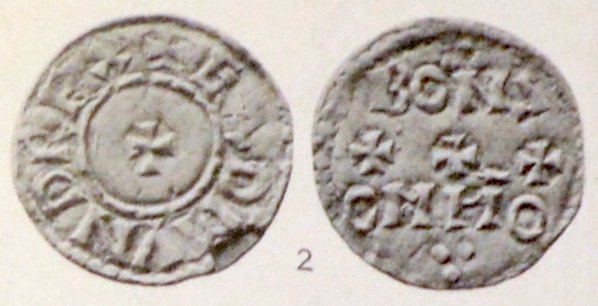
The coin illustrated here connects Edmund’s name with a physical object from the age he ruled. Coins are valuable evidence because they survive independently of the much later portraits and narrative accounts through which many readers encounter early kings.
Dunstan and Glastonbury
Edmund’s reign also belongs to the early history of the monastic revival that became prominent later in the tenth century. He made Dunstan abbot of Glastonbury, giving an important religious leader a base from which to work.
The British Library’s account of Dunstan places him in the intertwined worlds of church and court. Glastonbury was more than a backdrop to Edmund’s story: it was a religious institution with close royal connections and would become his burial place. Glastonbury Abbey’s historical timeline records the burial of both Edmund and his son Edgar.
Who were Edmund’s wives and children?
Edmund married Ælfgifu, associated with Shaftesbury, and later Æthelflæd of Damerham. His sons by Ælfgifu were Eadwig and Edgar. Both would eventually become kings.
They did not immediately inherit when their father died. His brother Eadred took the throne in 946; Eadwig followed in 955, and Edgar later ruled the whole kingdom. Their childhood at the time of Edmund’s death helps explain why the succession first passed to an adult brother.
How did Edmund I die?
Edmund was killed at Pucklechurch in Gloucestershire on 26 May 946, aged about twenty-five. The Royal Family’s biography describes his murder at a feast in his own hall.
The Chronicle identifies a killer named Liofa. A later account by John of Worcester says Edmund was trying to rescue his steward from the attacker. The distinction is important: the date and place of his death are well established, while the detailed scene comes through a later narrative. We cannot reconstruct every movement or motive in that hall with certainty.
What did Edmund I look like?
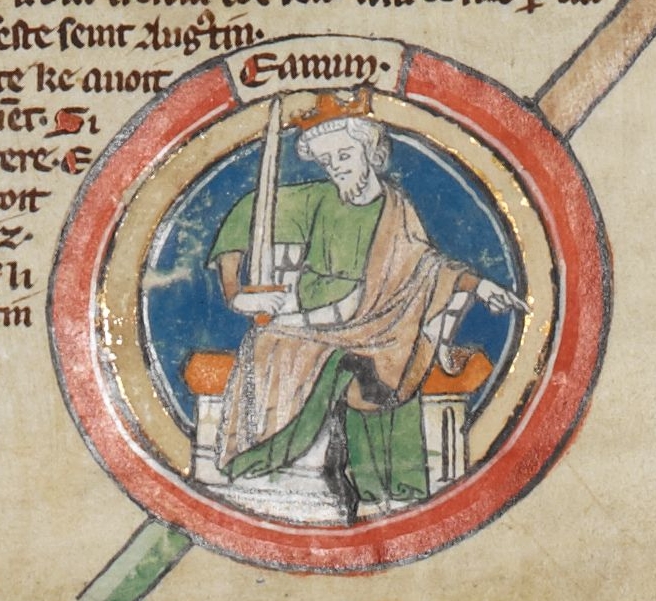
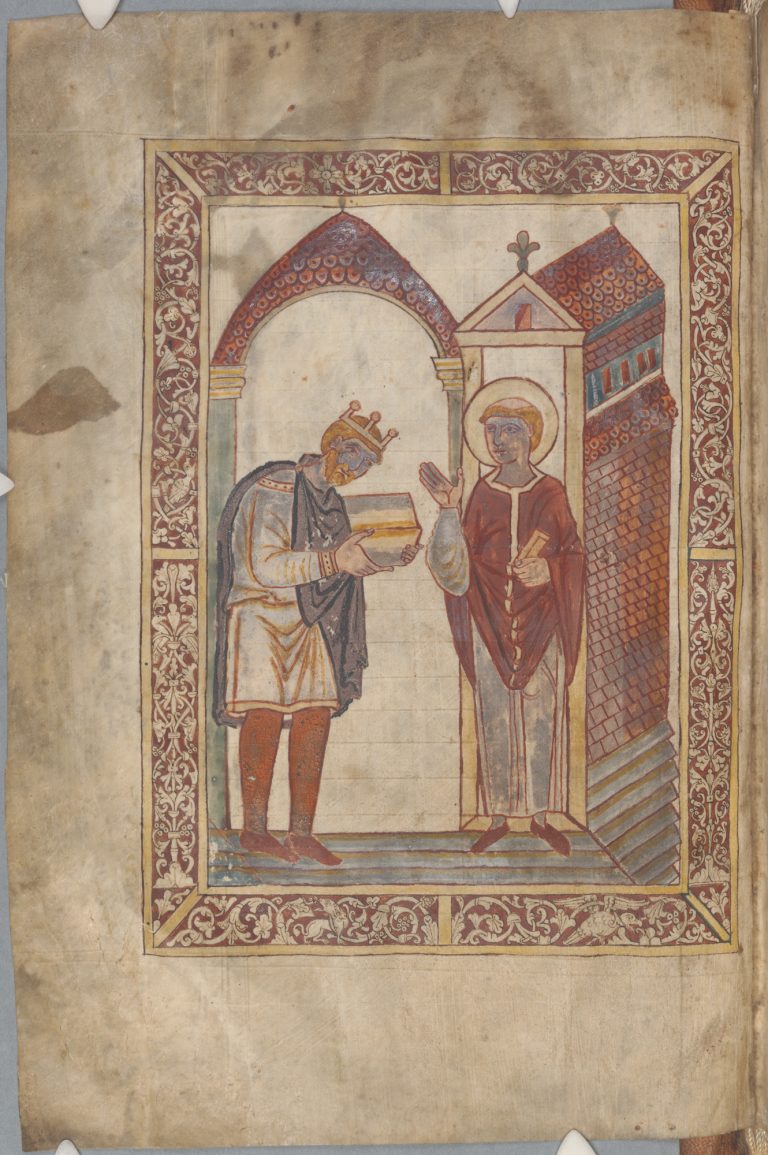
The manuscript image accompanying this article was made centuries after Edmund lived. It comes from a fourteenth-century royal genealogy, British Library Royal MS 14 B VI. It shows how a medieval artist represented the king, not a verified likeness drawn during his reign.
His place in England’s early history
Edmund inherited a kingdom whose unity still depended on military strength, political cooperation and the authority of the ruling family. His recovery of the Midlands and York kept that project alive.
His short reign connects Æthelstan’s unification with the later rule of Eadred, Eadwig and Edgar. Following his story makes the early English monarchy look less like an uninterrupted succession of settled rulers and more like a kingdom repeatedly tested, repaired and passed on.
If you want your photos bringing back to life, send me a message on any of my social media accounts.
Follow me across social media for historical photo restorations, AI colorizations, and videos bringing the past to life!
Instagram: https://www.instagram.com/bringing_history_to_life/
Facebook: https://www.facebook.com/bringinghistory2life
TikTok: https://www.tiktok.com/@bringing_history_to_life
YouTube: https://www.youtube.com/@bringing_history_to_life


One Comment