Dr. Hermann Rorschach and the Inkblot

Hermann Rorschach developed his inkblot method over several years. Rather than locating a breakthrough in a single imagined scene, his career can be followed through medical appointments, experiments and surviving test materials.
Rita Signer’s biography in the Historical Dictionary of Switzerland places his first inkblot experiments during his work at Münsterlingen between 1909 and 1913, and a renewed phase of experiments around 1917. The published test followed in 1921.
Completing His Medical Studies
Born in Zurich in 1884, Rorschach studied medicine between 1904 and 1909 in Zurich, Berlin and Bern. He completed his doctorate under Eugen Bleuler in Zurich in 1912. These dates distinguish his medical studies from the later doctoral qualification.
💡 The Seeds of the Inkblot Idea
His interests in images, perception and psychiatric practice developed together. The surviving chronology does not establish one decisive moment in 1910 when the finished test was conceived.
- A Childhood Obsession: As a child, Rorschach was known by the nickname “Kleck” (German for “inkblot”) because he loved Klecksography, a popular game where one folds a piece of paper with ink to create a symmetrical image. His father, an art teacher, had encouraged his visual and artistic interests, which never left him.
- Early Perception Experiments: While still a medical student and young physician, Rorschach began showing inkblots to schoolchildren and analyzing their responses, initially interested in it as a perception experiment—a way to study how different people see and process the world visually.
- Doctoral Work: Rorschach’s 1912 dissertation was titled “Reflex Hallucinations and Related Phenomena,” as recorded by the University of Bern’s Rorschach Archives and Collection. It concerned relationships between perception and experience. The archive’s biography is a useful starting point for distinguishing his early research from later interpretations of his test.
His work developed over time rather than beginning as a finished theory in 1910. The Bern archive preserves test cards developed in 1918 and used as the models for publication in 1921, alongside manuscripts and scored records. These materials allow historians to follow the development of his method.
Why He Became Well Known: The Rorschach Test
Hermann Rorschach is remembered today almost exclusively for the psychological tool he developed: the Rorschach Inkblot Test.
An Experiment in Perception
Rorschach noticed that people with different personality types, and especially those with different psychiatric diagnoses like schizophrenia (a term coined by his mentor, Bleuler, around 1908), tended to see things very differently in the same blots.
The Rorschach Archives at the University of Bern describes his work as a perception-diagnostic experiment, or form-interpretation test. Later psychologists developed projective interpretations of inkblot responses. Those later theories should not be read back into every stage of his original research, or presented as proof that an image response directly reveals a person’s unconscious thoughts.
A Systematic Approach
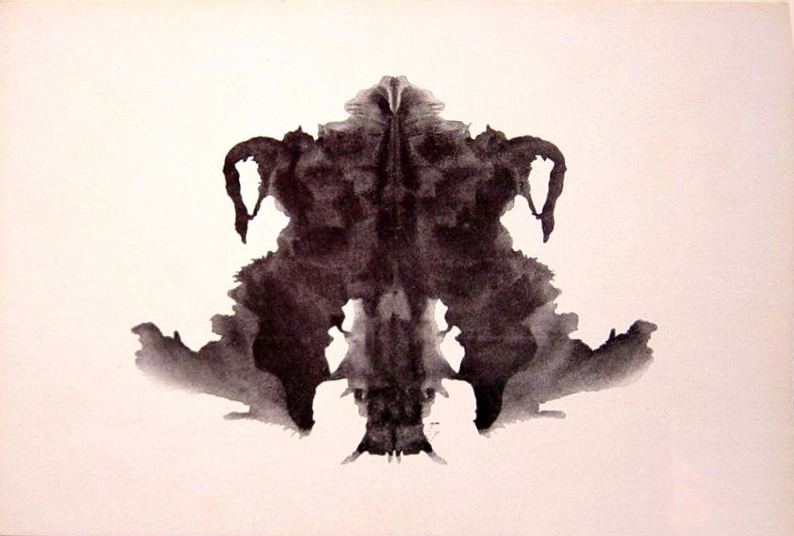
Rorschach’s genius wasn’t just in using inkblots—others had done that before him—but in making the process systematic and measurable. His test, published in his 1921 book Psychodiagnostik, consisted of ten specific, bilaterally symmetrical inkblots , five of them colored and five achromatic (black and white). He developed a comprehensive scoring system that analyzed several factors of the patient’s response:
- Location (W, D, Dd): Did they use the whole blot, a common detail, or a tiny detail?
- Determinant (F, C, M): Was the response based on the Form, Color, or perceived Movement?
- Content (H, A, Sc): What did they see (Human, Animal, Science)?
He believed the way a person constructed their response revealed their personality traits and cognitive processes far more than the content of the image they saw. Though controversial, the Rorschach test became one of the most famous and widely used tools in clinical psychology for decades, securing Hermann Rorschach’s lasting fame in the history of science.
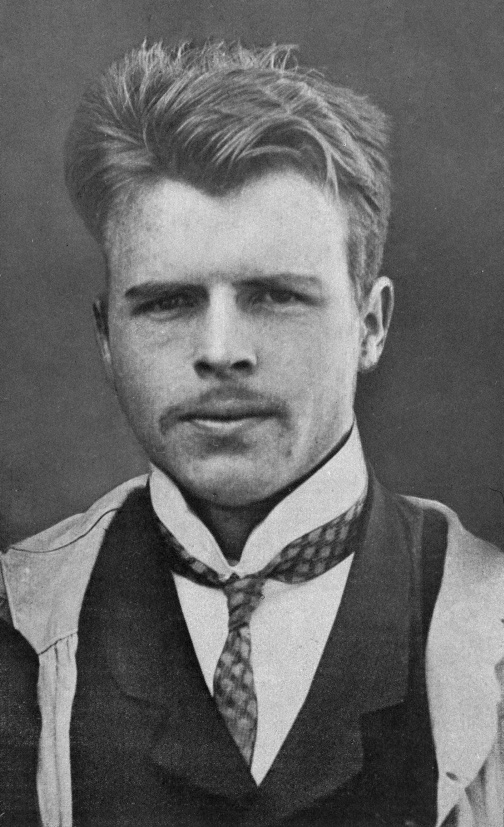
The photograph of Hermann Rorschach, the great psychologist, taken over a century ago in the nascent years of his career, possesses a stillness typical of the 1910s. It is an image in shades of monochrome, a captured moment that offers a glimpse of the man who would later define how we understand visual projection and personality.
But what if that stillness could be broken?
I took that archival portrait and undertook a delicate, multi-stage digital revival, treating the image as both a historical document and a canvas for modern innovation.
The displayed restoration is a digital interpretation of a historical portrait. Enhancement can make a small reproduction easier to view, but reconstructed sharpness may include new detail rather than information recoverable from the source. Compare it with the monochrome image rather than treating every added contour as documented.
The colorized version uses inferred colors. The monochrome portrait does not establish the exact colors of Rorschach’s skin, clothing or surroundings. A plausible palette can help modern viewers engage with the photograph, but it is not evidence of how the scene actually looked.
The video adds AI-generated motion to the still portrait. Its movements are synthetic, not authentic film of Hermann Rorschach.
The gaze, smile and head movements shown in the animation were generated for this interpretation. They cannot establish his real mannerisms, mood or thoughts at the time of the photograph.
The restored image and animation are modern creative works displayed alongside the historical source. They offer a way to engage with the portrait, while the original photograph and archival documents remain the evidence for historical claims.

Watch him move!
Get Your Images Done Too
If you want your images brought to life message me on Instagram.
Follow my other socials:
📌 Facebook: bringinghistory2life
📸 Instagram: bringing_history_to_life