Emperor Norton: San Francisco’s Self-Proclaimed American Emperor
Emperor Norton had no palace, army or constitutional authority. He had a uniform, a pen and a city willing to listen. In September 1859, the San Francisco resident announced that he was Emperor of the United States. The declaration became the beginning of one of America’s most unusual public lives.
His name was Joshua Abraham Norton. Newspapers printed his proclamations, photographers recorded his appearance and generations of San Franciscans kept telling his story. That lasting affection has also produced a problem: some of the best-known Norton stories are poorly documented. The real man is interesting enough without treating every entertaining legend as fact.
Before the imperial uniform
Norton was born in England and grew up in South Africa. The Emperor Norton Trust’s research on his early life favors February 4, 1818, as his birth date, while acknowledging the difficulty of establishing it. He later reached San Francisco and became a prosperous businessman in importing and real estate.
A disastrous rice transaction in 1852 and the litigation that followed helped destroy that prosperity. Norton tried to escape the purchase contract, but the California Supreme Court ruled against him in 1854. He filed for insolvency in 1856. The surviving record does not support a neat story in which he instantly vanished after one failed deal and returned as an emperor. Business advertisements and civic activity continued during the intervening years.
That distinction gives him back a life between two famous moments. Bankruptcy did not erase him from the city. He still had plans, acquaintances and a place in public affairs. The temptation to reduce his story to a single psychological turning point is stronger than the evidence for doing so.
The proclamation that made an emperor
The clearest starting point is the proclamation published in the Daily Evening Bulletin on September 17, 1859. Norton claimed that a large majority of Americans wanted him to assume the title. He then instructed representatives of the states to assemble in San Francisco and change the nation’s laws.
The document’s purpose went beyond announcing a grand name. It presented the country as troubled and proposed a meeting intended to restore confidence in its institutions. Norton signed as emperor, borrowing the language of lawful authority even though no public process had given him that authority.
Reading the original declaration is more revealing than simply calling him eccentric. It shows his preferred method: publish an instruction, address a public problem and speak as though compliance should follow. He placed himself above ordinary politics while continuing to depend on the newspapers that made his words visible.
Orders that could not be enforced
An October 1859 proclamation abolishing Congress illustrates the scale of his claims. The declaration had no legal force. Its historical interest lies in the gap between the sweeping command and the ordinary citizen issuing it.
The Virtual Museum of the City of San Francisco’s chronology records later orders against party conflict, demands for improvements in Sacramento’s streets and a call to support airship experiments. These subjects bring the emperor closer to the daily concerns of a growing western city. Transportation, public services and political quarrels sat alongside imperial ceremony.
The same chronology records his 1867 arrest for involuntary treatment and the outcry that followed. Police Chief Patrick Crowley ordered his release. The episode suggests that his place in San Francisco involved more than an audience laughing at a costume. Public sympathy could have practical consequences when an official tried to remove him from the streets.
Did Emperor Norton predict the Bay Bridge?
Norton called for a bridge connecting Oakland and San Francisco by way of Goat Island, now Yerba Buena Island, in 1872. He also proposed a survey considering a bridge or tunnel. The museum’s chronology preserves these proposals among his civic pronouncements.
Calling this a prediction can blur what happened. Norton advocated a transport connection. He did not produce the engineering plans for the bridge eventually built in the twentieth century. His idea nevertheless belongs to the history of imagining how the bay might be crossed. It is possible to appreciate that foresight without giving him credit for work done by later engineers and builders.
The “Frisco” story needs a warning label
One familiar tale claims Norton imposed a fine on anyone who shortened San Francisco to “Frisco.” The Emperor Norton Trust’s investigation of the alleged decree found no contemporary primary document establishing that he wrote it. Its research traces the frequently repeated wording to a much later account.
This is a useful example of how a legend grows. A quotation sounds exactly like the kind of thing a colorful historical figure might have said. Writers repeat it, and repetition begins to stand in for evidence. The responsible choice is to describe the attribution as unsupported, rather than print it as an amusing fact.
The uncertainty does not make the entire Norton story unreliable. His portraits, published proclamations and recorded presence in the city provide substantial evidence. Each claim needs its own assessment. A doubtful joke should not discredit an authentic document, and an authentic document should not give every later joke a free pass.
The person in the photograph
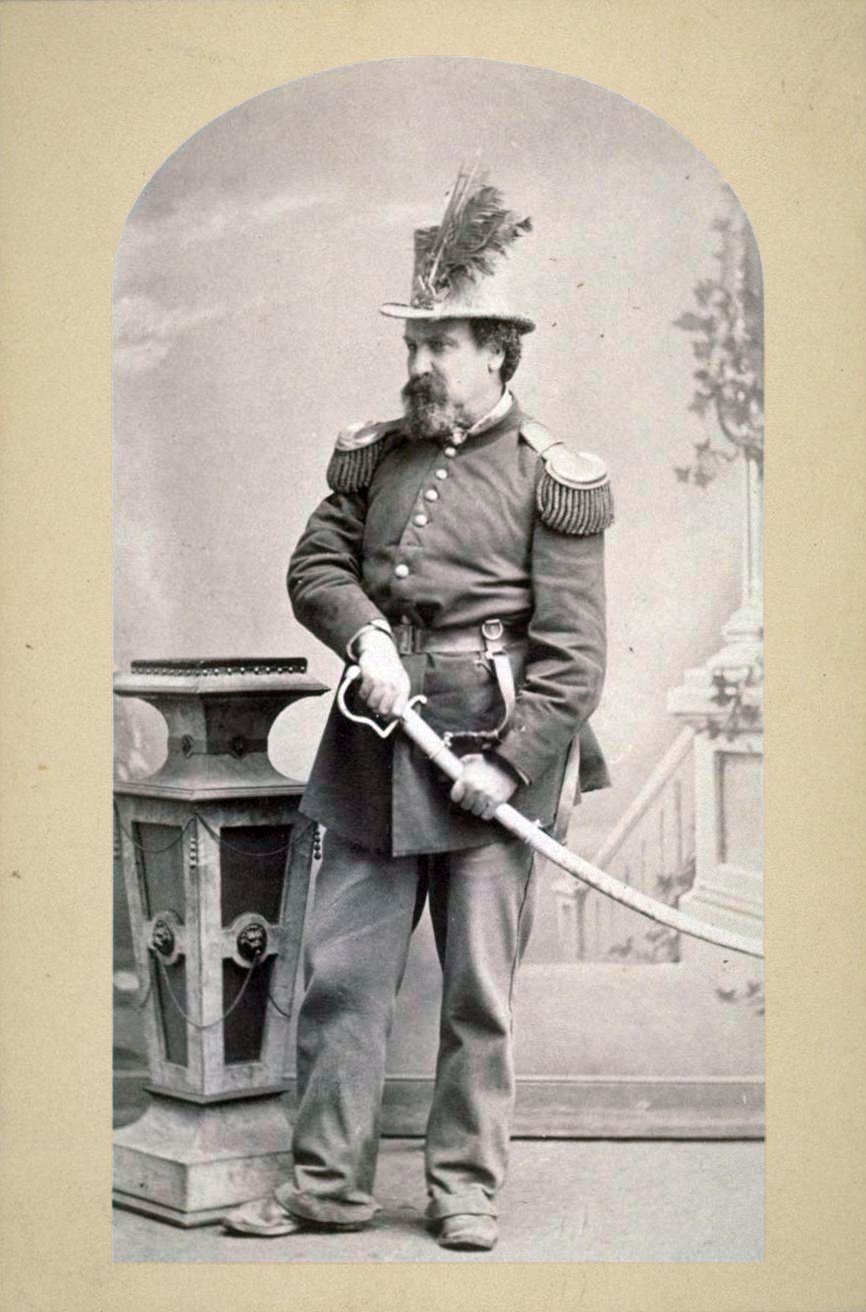
The portrait at the top shows Norton wearing the dress of his self-appointed office. Its identification is supported by the archival source recorded on the image page. The uniform helps explain why he remained so memorable: it made his chosen role visible before he said a word.
Norton died on January 8, 1880. The museum chronology records public mourning and his later reburial in Colma in 1934. His reputation survived because San Francisco continued to find meaning in a man who had claimed an impossible office and made himself part of the city’s everyday life.
We cannot diagnose him from a photograph, and there is little value in turning his difficulties into a punch line. The better story follows the documents: a businessman suffered severe losses, adopted an imperial identity and remained a recognizable civic presence. The city’s response became part of his history, too.
Explore more remarkable people in our history articles.
Get Your Images Done Too
If you want your photos bringing back to life, send me a message on any of my social media accounts.
Follow me across social media for historical photo restorations, AI colorizations, and videos bringing the past to life!