Eugen Sandow: The Victorian Strongman Who Made His Body a Business
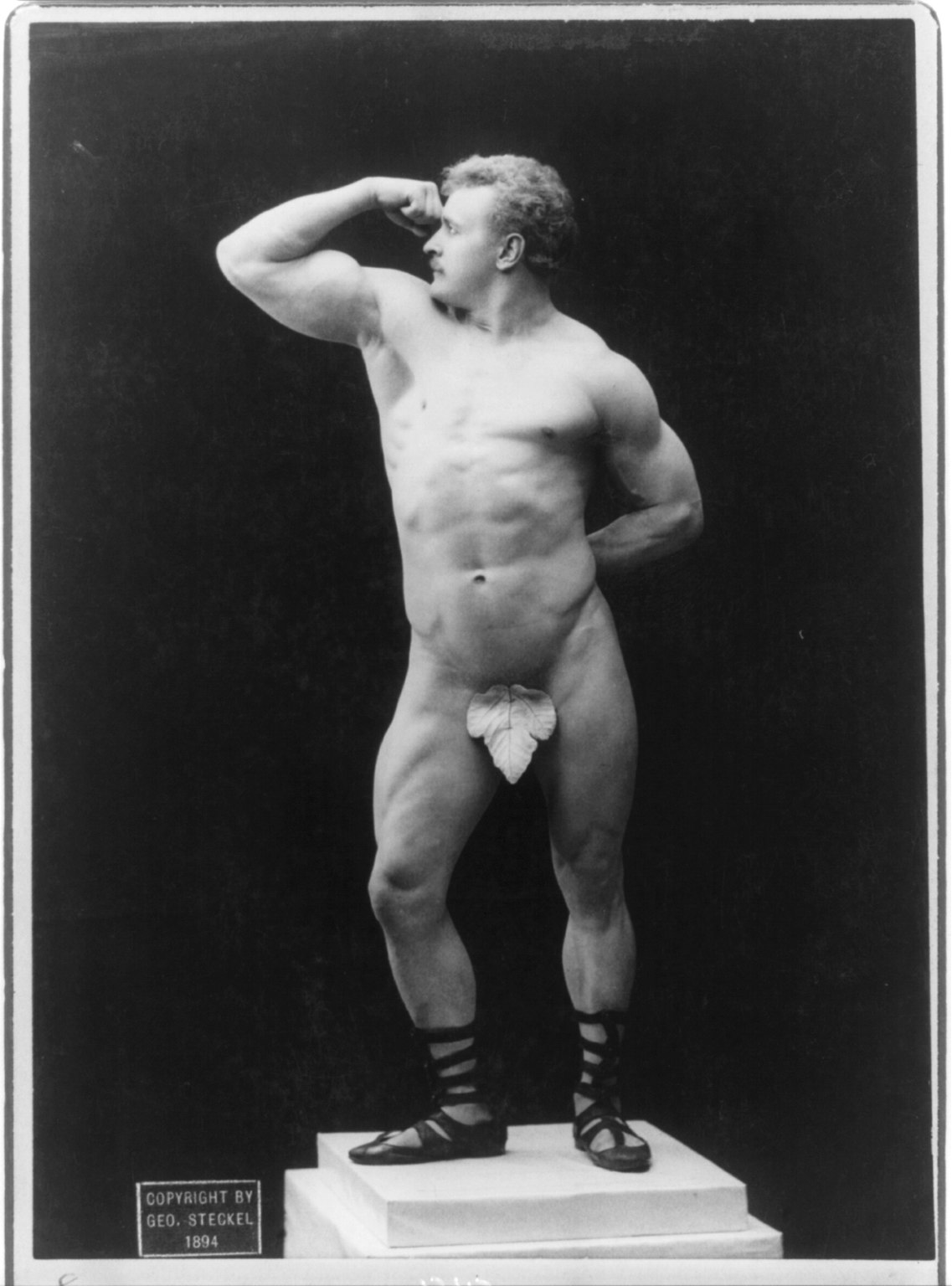
Featured photograph: Eugen Sandow in 1894, photographed by George Steckel. Library of Congress. Public domain. Source and rights.
Eugen Sandow understood that a strongman could sell more than a lifted weight. He could sell an image of what a human body might become. In carefully arranged photographs, he flexed, turned and posed like a classical statue that had suddenly started moving.
The result was a career stretching across music halls, exercise books, early motion pictures and a major physique competition. Long before fitness celebrities could reach an audience through a phone, Sandow made his own body the center of an international business. His story also reveals uncomfortable assumptions about who was allowed to represent physical “perfection.”
A strongman becomes a spectacle
Born Friedrich Wilhelm Müller in Prussia in 1867, Sandow became a circus athlete before winning attention in London in 1889. His muscular appearance was not an incidental part of the act. It became the attraction itself. He could present the body as a feat of training and as a work of art.
The Natural History Museum’s account describes his use of lighting and posing to emphasize his physique. That shift changed the question put to the audience. Instead of asking only how much a man could lift, Sandow invited people to look at how he was built.
Strength and appearance were related, but they were not the same thing. A theatrical pose could be held, photographed and reproduced. It gave an audience time to study a shoulder or an arm. It also gave a promoter a memorable image to place on a poster, in a book or beside a product.
What the advertising promised
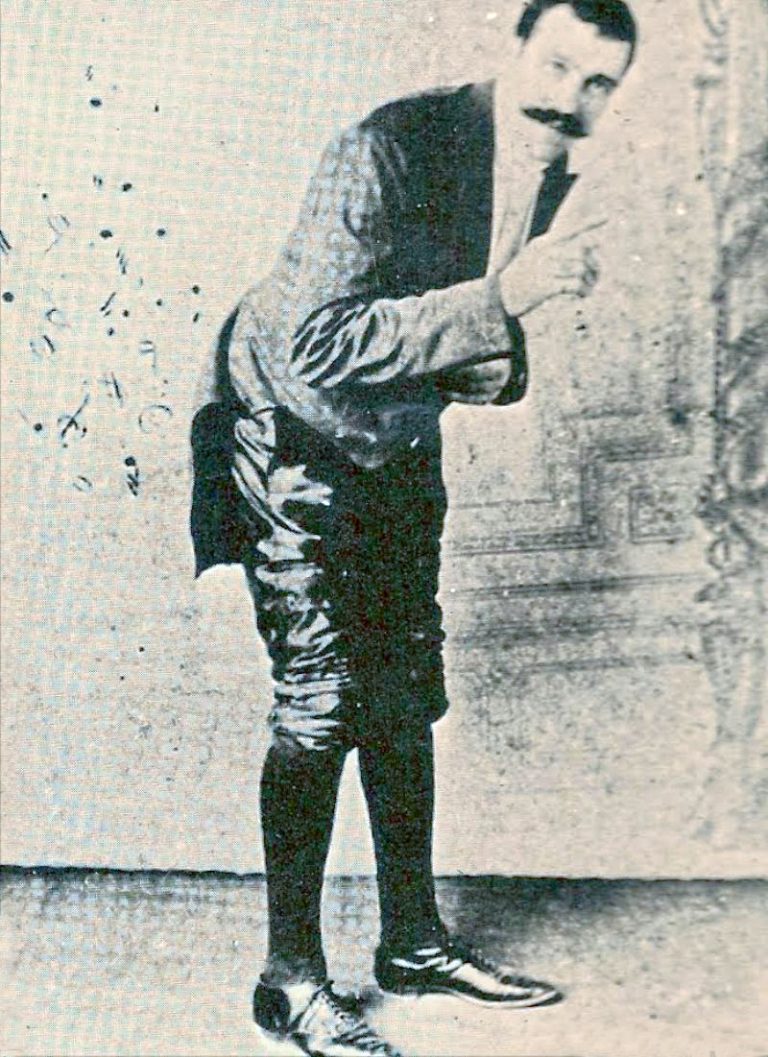
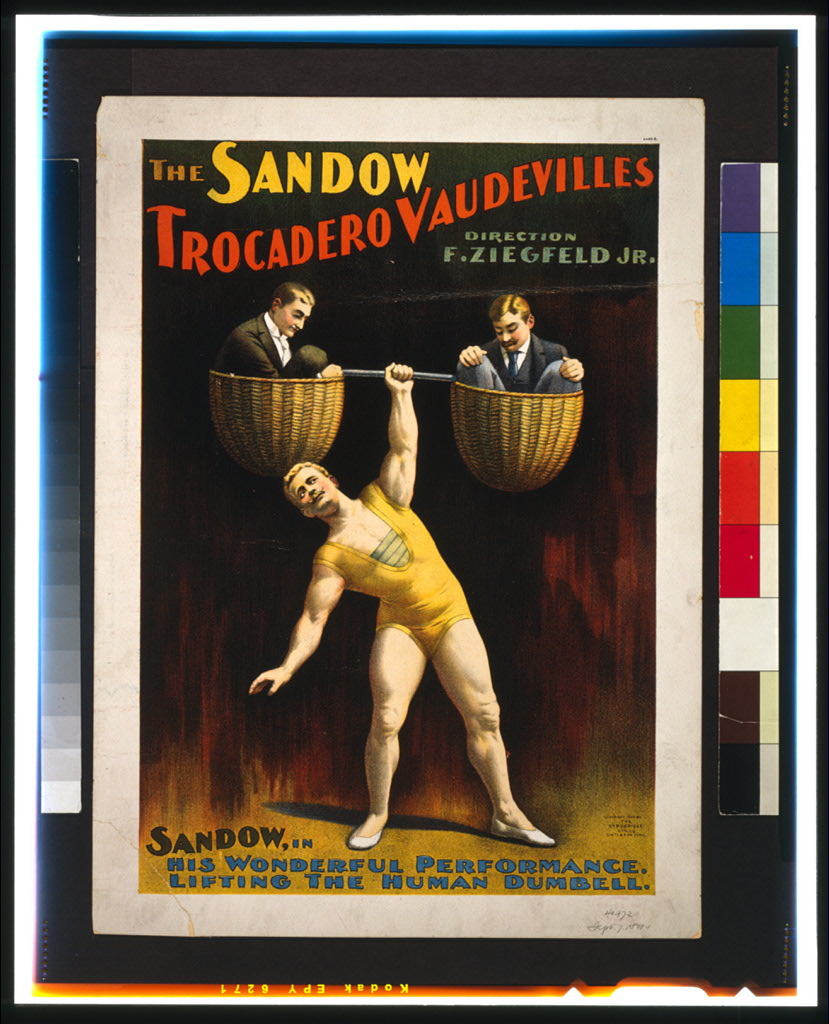
An 1894 Strobridge poster preserved by the Library of Congress advertises Sandow lifting a “human dumbell,” with people serving as the dramatic ends of the weight. Florenz Ziegfeld Jr. is named as the director. The picture belongs to the exuberant visual language of vaudeville advertising.
It is important to call the object what it is: a promotional illustration. It is not a camera record that independently verifies the precise weight, position or circumstances of a performance. Its historical value includes the way it tells us what the public was being asked to imagine.
That distinction makes the picture more useful, not less. A photograph of a studio pose, an advertisement for a feat and a motion-picture sequence provide different kinds of evidence. Treating them all as interchangeable proof would erase the choices made by photographers and show-business promoters.
Sandow enters the moving-picture age
In 1894 Sandow was filmed at Edison’s Black Maria studio. The Library of Congress history of Edison’s early productions places him among a stream of performers whose established stage skills supplied material for the new camera. Dancers, athletes and entertainers could offer short, visually clear actions without needing a complicated plot.
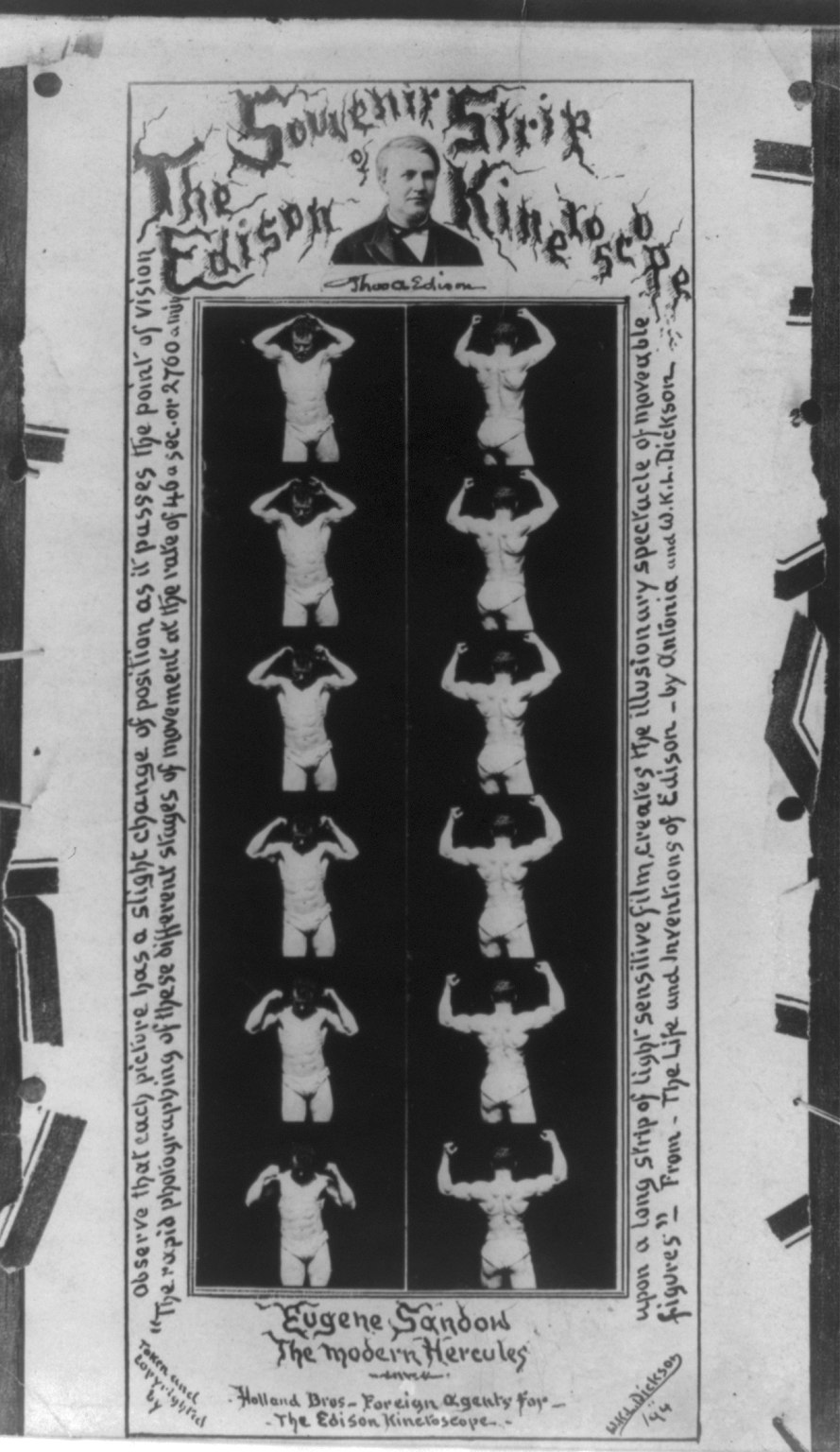
A surviving souvenir sheet shows Sandow in a sequence of poses. The body changes position while the viewer’s attention remains fixed on muscle and movement. The photograph was no longer only a way to preserve an ideal pose. A series of photographs could show the transition from one pose to another.
He also appeared in a later American Mutoscope production. The Library of Congress catalog for the 1896 Sandow film describes him posing against a dark background, displaying his arms and back, then performing a standing backflip. This is a useful reminder that his appeal did not require an enormous barbell in every scene.
Watching an actual performance can challenge the still photograph. A posed body looks fixed and almost sculptural. A moving performer must change balance, breathe and finish an action. The difference helps recover the skilled entertainer behind an image that later bodybuilding culture made iconic.
Turning photographs into instructions
Sandow also offered readers a system they could buy and follow. His 1894 training manual combined photographs with other illustrations. The University of Alberta’s exhibition of the book explains how the pictures drew connections between his living body and classical sculpture.
The format was persuasive. Readers did not have to rely entirely on a written description of an exercise or a claim about results. They could see the author who was selling the method. At the same time, a photograph of an exceptional performer was not a guarantee that every reader would acquire the same physique.
These pages belong to the history of physical culture, not to present-day individualized exercise advice. Their appeal tells us about aspirations, marketing and the authority attached to photographic evidence. Sandow’s business depended partly on making personal transformation look tangible enough to order, practice and display.
The Great Competition of 1901
On September 14, 1901, Sandow’s Great Competition took place at the Royal Albert Hall. The venue’s own performance record names William L. Murray as the winner and lists Sandow, sculptor Charles Lawes and Arthur Conan Doyle among those responsible for judging.
The evening was more than a line of men waiting to be measured. Its program included music, athletic displays, a procession of competitors and Sandow’s own strongman act. A contest over bodily development was being packaged as a substantial public entertainment.
The presence of an artist and the creator of Sherlock Holmes is part of what makes this episode distinctive. Sandow had brought physical culture into a setting associated with respectable public events. The body was something to train, exhibit, compare and reward, not merely a tool for one astonishing stunt.
The problem with a “perfect” body
That same year, a cast of Sandow’s body was made for the museum now known as London’s Natural History Museum. Its curator’s ambition included classifying supposedly ideal racial types. The museum’s modern account identifies that racist framework rather than treating it as neutral science. The cast was displayed only briefly before being removed.
Sandow died in 1925, but his photographs remain remarkably recognizable. They preserve both an individual performer and a carefully constructed public image. To look at them critically is to notice the artistry without accepting the idea that one physique defines human worth. The most interesting thing about Sandow is not that he was “perfect.” It is how successfully he made that claim into a career.
Find more remarkable lives and the images behind them in our history articles.
Get Your Images Done Too
If you want your photos bringing back to life, send me a message on any of my social media accounts.
Follow me across social media for historical photo restorations, AI colorizations, and videos bringing the past to life!