Calamity Jane: The Woman Behind the Wild West Legend
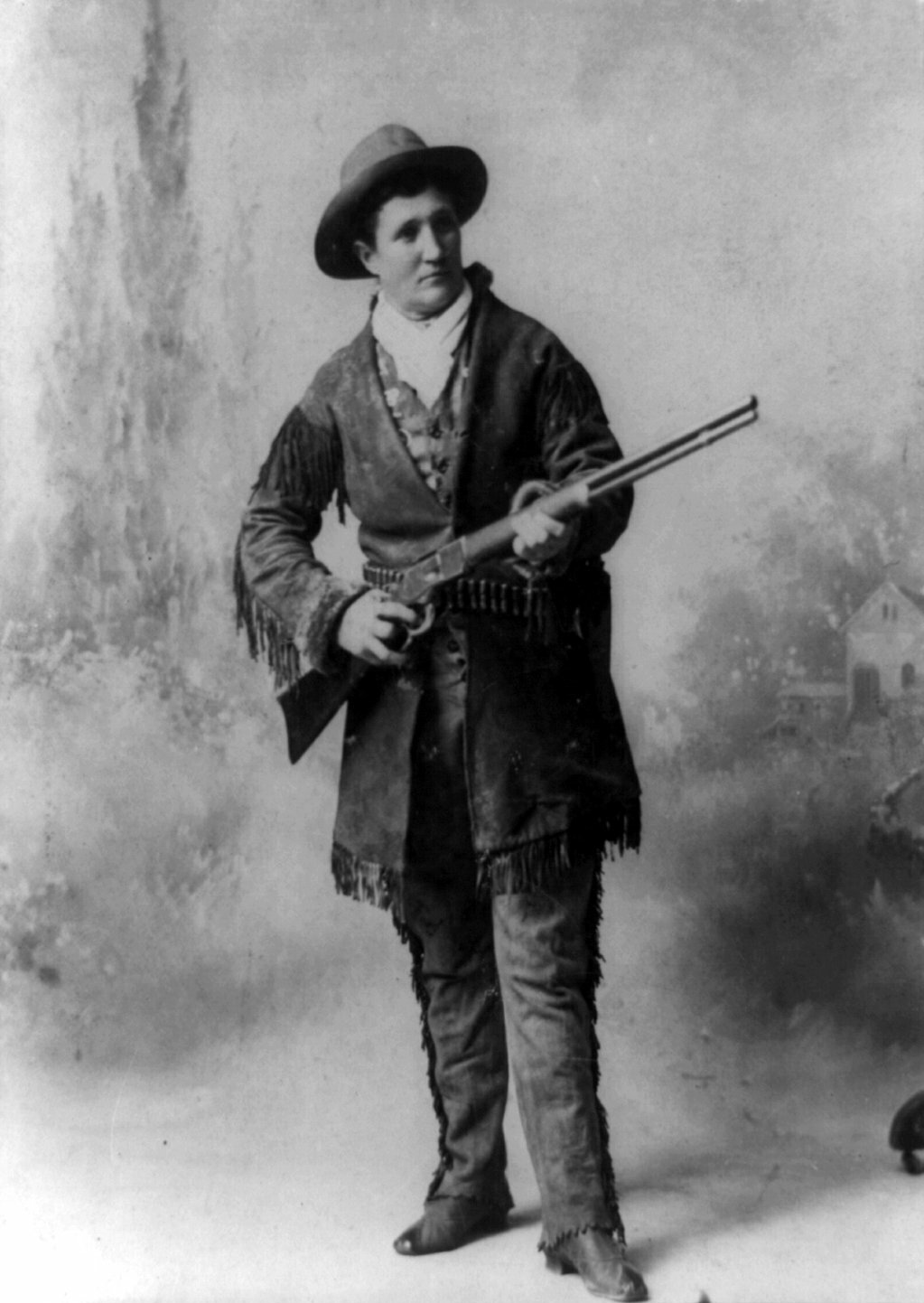
Featured photograph: Martha Canary, better known as Calamity Jane, in an H. R. Locke photograph, circa 1895. The costume and rifle contributed to her frontier image. Library of Congress. Public domain. Source and rights.
The woman in the photograph seems ready to step directly into a Western: rifle in hand, practical clothing, and a name that sounds invented for a theater poster. Calamity Jane understood the value of that image. The difficulty is that the image became so successful it nearly swallowed the person.
Her real name was Martha Canary. She traveled through the nineteenth-century American West, worked precarious jobs, became a recognizable frontier celebrity, and eventually sold versions of her own life to curious audiences. The stories grew spectacular. Sorting them out reveals someone more complicated than either a fearless fictional heroine or a collection of exposed falsehoods.
Martha Canary before the legend
Even her birth date needs care. Her autobiographical pamphlet gave May 1, 1852, while historian James D. McLaird’s Encyclopedia of the Great Plains biography places her birth in 1856 near Princeton, Missouri. The disagreement is a warning against treating every familiar detail as settled.
Her family moved west during her childhood. Her parents died while she was still young, leaving a life shaped by displacement and insecurity. The adult Martha worked at occupations that rarely brought lasting comfort or prestige, including laundry and restaurant work. Celebrity did not necessarily mean financial security.
That contrast is important when looking at the photographs. A studio portrait freezes a deliberate appearance. It cannot tell us whether the sitter had steady employment, a safe place to sleep, or money for the next journey. The confident frontier character and the vulnerable working woman could exist at the same time.
A famous name without a simple origin
In her own account, Jane explained her nickname through a dramatic rescue. She claimed that she saved a wounded officer named Egan and received the title Calamity Jane as a reward for her courage. It is a good story, neatly structured around danger, action, and recognition.
It is not a story that should be repeated as established fact. Her 1896 autobiographical pamphlet contains numerous claims about military service and exploits that historians have challenged. Reading it is valuable, but its value is partly as evidence of the character she presented to the public.
There is a useful distinction between asking why a name caught on and asking whether its owner’s explanation is reliable. The name promised a particular kind of person: unconventional, dangerous, and difficult to ignore. Once it circulated, every new anecdote could strengthen that promise, whether or not the anecdote was true.
Deadwood, Wild Bill, and a lasting misconception
Jane arrived in the Black Hills during the gold-rush era. Her association with Wild Bill Hickok became one of the most persistent elements of her later legend. They knew one another, but the great romance familiar from popular entertainment is not a securely documented relationship.
Hickok was killed in Deadwood in August 1876, only weeks after their arrival in the same traveling party. That brief overlap became raw material for much larger stories. Jane’s eventual burial near him made the connection visible in the landscape, but neighboring graves are not proof of a romantic history.
The City of Deadwood’s historical brochure follows the life behind the famous name and her final years. For visitors, the grave remains a powerful encounter with the legend. It is worth carrying the distinction between commemoration and evidence into that encounter.
The autobiography was also an advertisement
Jane’s short life story does not merely look backward. Its ending points readers toward her appearance at a Minneapolis museum in 1896. This is a revealing detail: the narrative helped promote a living attraction. An audience could read about the extraordinary woman and then pay to see her.
The pamphlet places her at the center of rescue after rescue. It presents her as a scout, messenger, protector of travelers, and avenger of wrongdoing. There is little space for uncertainty or ordinary labor. The structure resembles an adventure serial more than a modern, carefully documented autobiography.
That does not make the document useless. It changes the questions we ask of it. What did audiences want to believe about a woman of the frontier? Which kinds of courage sold tickets? How could an aging celebrity earn money from a reputation that others were already exploiting? The pamphlet lets us study those questions even where its literal claims fail.
The real woman inside the publicity photograph
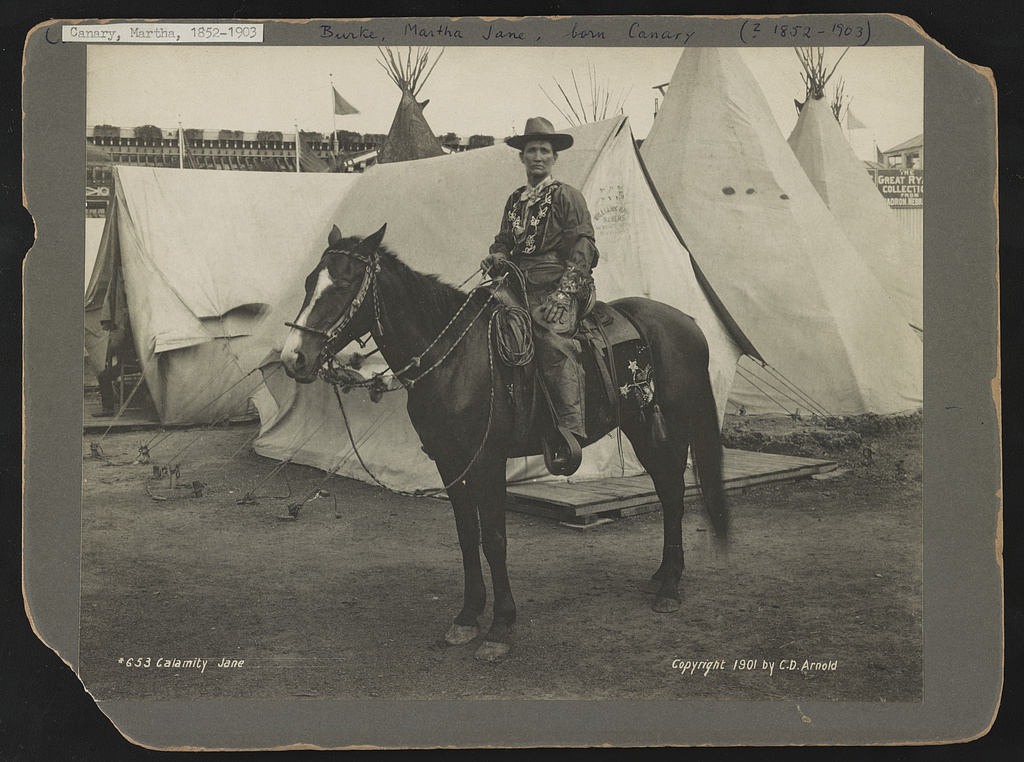
A photograph taken at the 1901 Pan-American Exposition shows Jane on horseback. The Library of Congress catalog identifies the sitter and setting; C. D. Arnold’s 1901 copyright notice is visible on the print. Here the frontier image has become part of an organized spectacle.
The picture is not a candid record of an isolated moment on an open trail. Tents, exhibition grounds, and the carefully presented rider place it in a performance environment. That context does not diminish its historical value. It makes the image more useful: we can see how a person associated with the West was displayed to a public hungry for Western experiences.
The earlier rifle portrait works in a similar way. Clothing, stance, and props communicate a role. They show how Jane was represented, but they cannot independently prove a claim that she served as a military scout. A photograph can be authentic while the story attached to it remains questionable.
More than a tall tale
Historian McLaird’s study of Calamity Jane’s life and legend separates the documentary record from the expanding popular character. The distinction also prevents a second mistake: assuming that correcting the legend leaves nothing worth remembering.
Jane’s life illuminates how fame could be made at the edge of respectability. Her public identity crossed expectations about women’s clothing, behavior, and independence. Yet admiration for the character did not remove the hardships of the person. The distance between applause and security could be painfully wide.
She died in Terry, South Dakota, on August 1, 1903, and was buried in Deadwood’s Mount Moriah Cemetery. The stories did not die with her. Fiction, stage entertainment, and film continued reshaping her into whatever kind of frontier woman a new audience wanted.
Looking carefully at Calamity Jane means resisting two easy endings. We do not have to believe every exploit, and we do not have to dismiss her because many exploits were invented or exaggerated. Behind the rifle, the nickname, and the publicity stood an actual woman trying to survive. Her photographs become more compelling, not less, when we allow that woman to remain complicated.
Explore more lives and historical photographs in our history articles.
Get Your Images Done Too
If you want your photos bringing back to life, send me a message on any of my social media accounts.
Follow me across social media for historical photo restorations, AI colorizations, and videos bringing the past to life!