Franz Reichelt: The Flying Tailor and His Fatal Parachute Suit
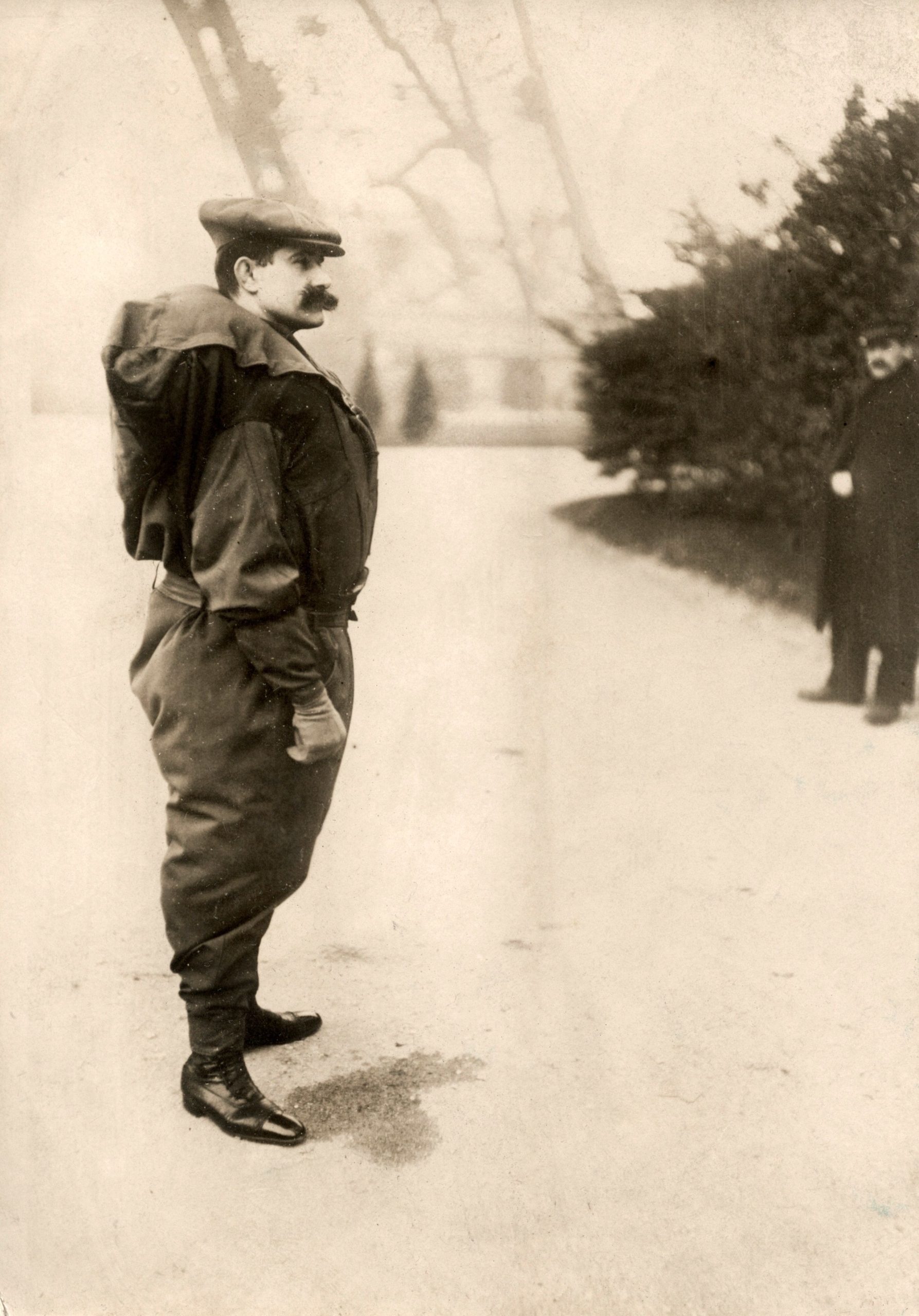
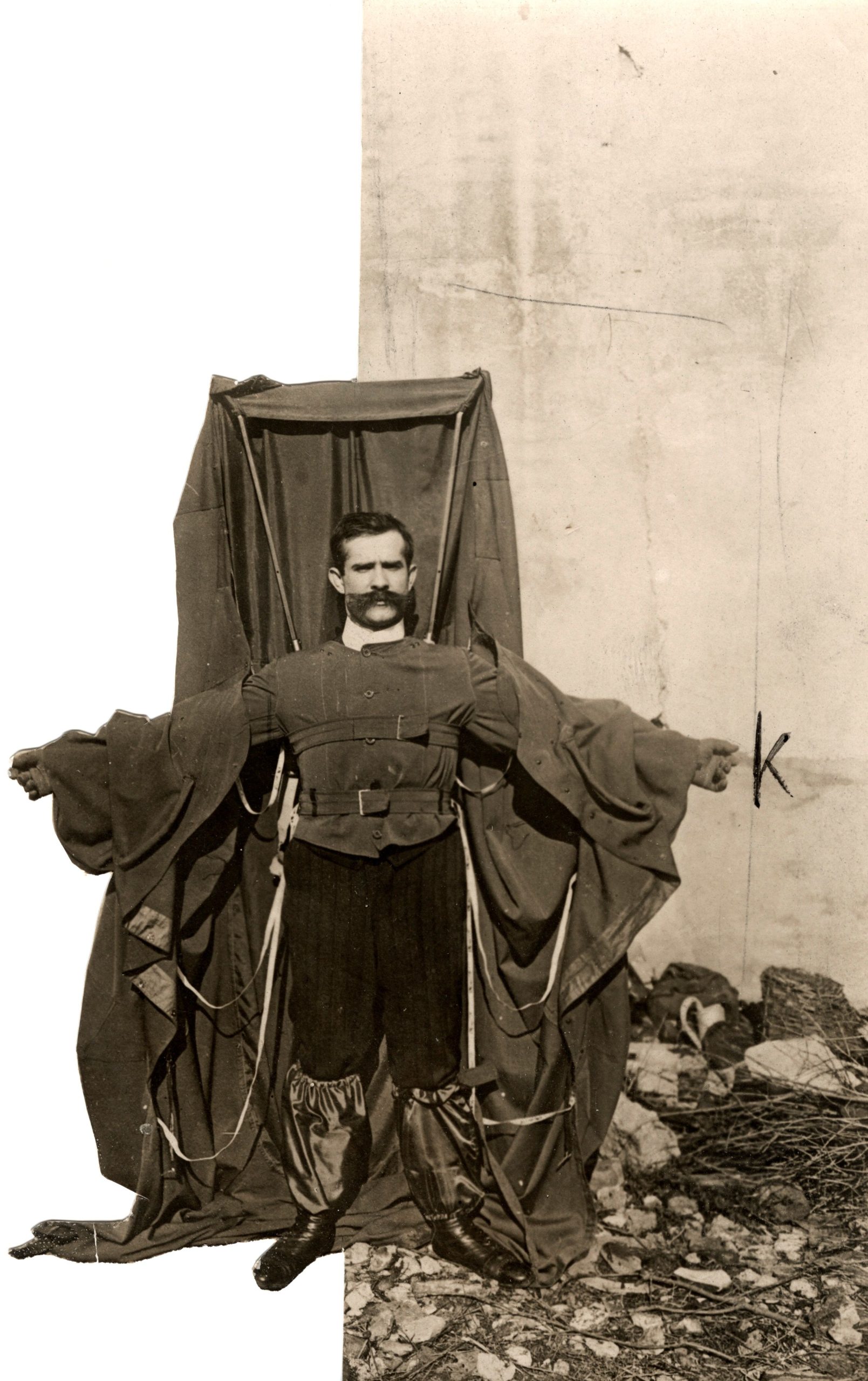
Featured photograph: Franz Reichelt wearing his parachute suit in 1912, before his fatal Eiffel Tower test. Spaarnestad Photo; public domain via Wikimedia Commons. Image source and rights.
In one surviving photograph, Franz Reichelt stands inside his invention with the fabric spread around him. It is a strange portrait because the clothing is also a proposal: a suit that might save someone falling from an aircraft. Knowing what happened next makes the picture difficult to study without turning it into a prediction.
On February 4, 1912, Reichelt tested his parachute suit by jumping from the first platform of the Eiffel Tower. He died when it failed. His story survives in still photographs, contemporary newspaper reports and a short film. Together, they reveal more than the familiar label of the Flying Tailor.
A Paris tailor with an aviation problem to solve
Born in 1878 in Bohemia, then part of Austria-Hungary, Reichelt moved to Paris in 1898. He worked as a tailor and became a French citizen in 1909. Accounts therefore call him Franz, Frantz or François. These variations generally refer to the same inventor, rather than to several different people.
His ambition was to create clothing that could become a parachute if an aviator had to leave an aircraft. The biographical overview of his experiments describes repeated revisions and tests with dummies. Promising early results did not become reliable success. Reichelt nevertheless believed that a higher starting point would allow his design to work.
That belief explains the attraction of the Eiffel Tower. It offered height, visibility and a recognizable setting. It could also turn a test into news. The distinction between those advantages matters: publicity could establish that a test had taken place, but it could not establish that the device was safe.
Why the Eiffel Tower?
The tower had already become connected with aviation experiments and public challenges. Its official historical account of aerial exploits places parachuting alongside airship and airplane demonstrations. Gustave Eiffel also carried out aerodynamic investigations, first using falling objects and later a wind tunnel.
This setting helps us understand why an inventor might look upward at the tower and see a testing platform. It does not make all experiments conducted there equally sound. A famous structure could host careful measurement, publicity-seeking feats and lethal misjudgments.
What the next day’s newspaper reported
A report published in Le Figaro on February 5, 1912 gives an immediate account of the attempt. Its author, Frantz Reichel, should not be confused with the inventor whose name differed by one letter.
The report describes a cold Sunday morning, a small gathering of reporters and photographers, and objections from people concerned about the design. According to the newspaper, Reichelt arrived already wearing the suit. He remained confident despite attempts to dissuade him.
Le Figaro also says there was a delay while permission to proceed was clarified with the tower’s management. Reichelt then climbed to the first platform with friends. The account describes the garment opening before his leap and failing to carry him safely to the ground.
This is valuable contemporary evidence, but it is also a newspaper story written after a fatal event. Its judgments about confidence and folly belong to the reporter. They should not be mistaken for access to every thought Reichelt had.
The film preserves a person, not his thoughts
The surviving footage is one reason this episode remains so widely remembered. A British Film Institute discussion of the Pathé film draws attention to the time Reichelt spends on the platform before jumping. The camera also records him demonstrating the suit beforehand.
Those moments can feel unusually immediate. A person dead for more than a century moves, turns and pauses in front of us. Yet the film is silent, and its explanatory titles frame the event after the outcome is known. Hesitation is visible; a particular private fear or intention is not.
For that reason, we do not need to replay the fatal fall here. The still portraits let us examine the inventor and his design without making the moment of death the centerpiece. They also avoid treating a preventable loss as a spectacle for its own sake.
What the photographs can tell us
The main image is cataloged as a 1912 photograph of Reichelt before the attempt. It comes from the Spaarnestad photograph collection through Wikimedia Commons. A companion photograph shows him displaying the opened fabric.
These are pictures of the actual inventor, rather than modern recreations. They record the garment’s appearance and its relationship to the wearer. They cannot, on their own, provide the measurements and test results needed to evaluate its performance. A dramatic photograph of an apparatus is evidence of its existence, not proof of its effectiveness.
Was Reichelt the inventor of the wingsuit?
Reichelt often appears in histories of wingsuit flying. A historical overview hosted by the Fédération Aéronautique Internationale includes his 1912 attempt among early efforts to combine a wearable wing with a parachute. The same overview describes later designs and developments over many decades.
It is more accurate to describe him as an early experimenter than to make his failed suit the single origin of modern equipment. Similar-looking inventions do not automatically form a direct line of descent. His place in the story rests on the attempt he made and the unusually extensive visual record it left.
Reichelt’s portrait holds both an intention and a limit. He wanted clothing to solve an urgent problem in flight. The surviving evidence shows that his conviction exceeded what his apparatus could deliver. Remembering the man means taking both parts seriously.
Find more remarkable lives in our historical biography collection.
Get Your Images Done Too
If you want your photos bringing back to life, send me a message on any of my social media accounts.
Follow me across social media for historical photo restorations, AI colorizations, and videos bringing the past to life!