Henry Paget: The Dancing Marquess Who Turned His Home into a Theater
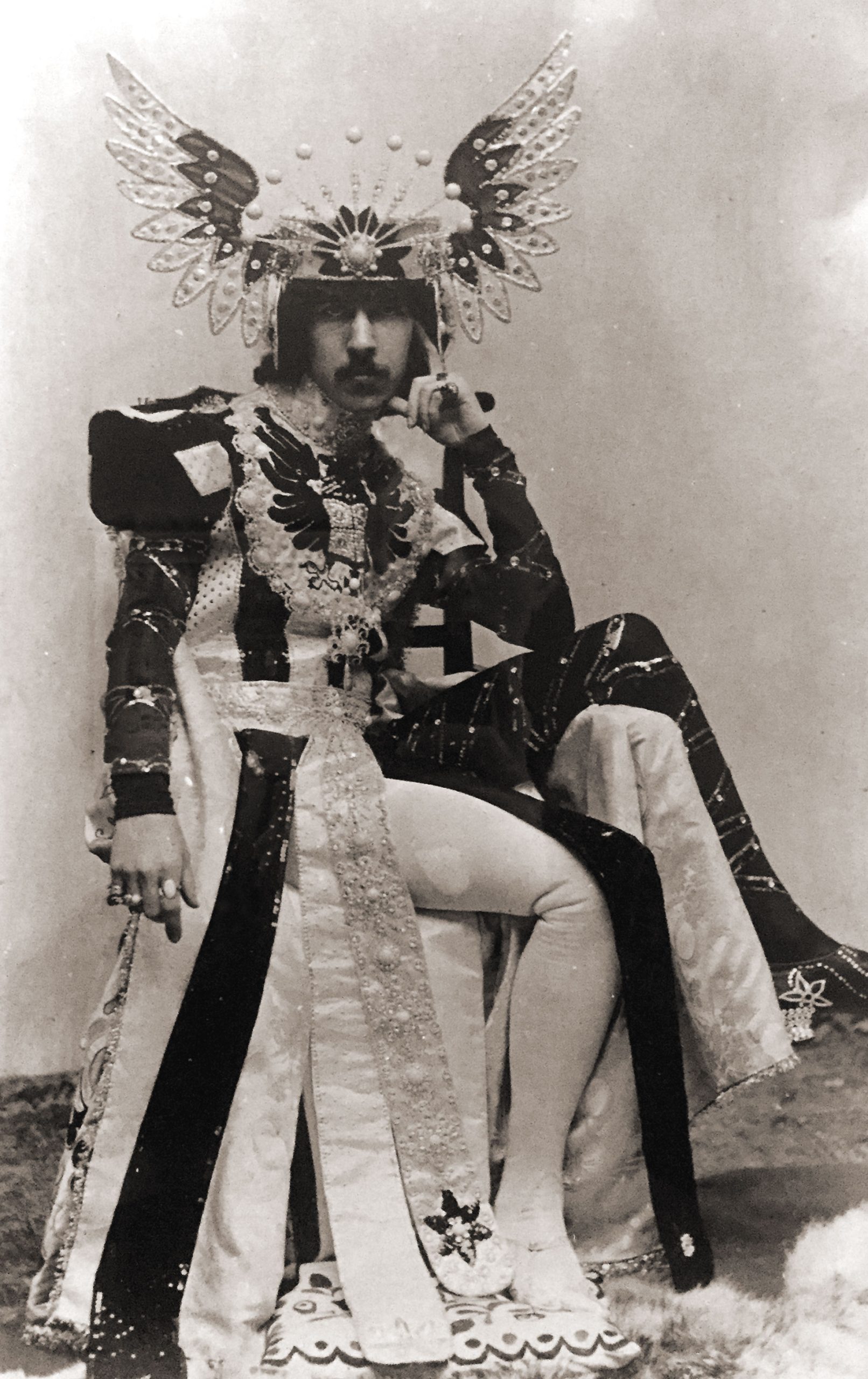
Portrait: Henry Cyril Paget, fifth Marquess of Anglesey, in theatrical costume, around 1900. Photograph by John Wickens. Public domain via Wikimedia Commons. Image source and rights.
Henry Paget did not dress for his portraits as though he hoped to disappear into the family album. In John Wickens’s photograph, the fifth Marquess of Anglesey wears an elaborate costume and a winged headpiece. The image looks almost like a character design for a fantasy film. It records a real aristocrat who made performance a central part of his life.
Paget became known as the Dancing Marquess. His story includes inherited wealth, a private theater, astonishing clothes and financial collapse. Yet the photographs invite a better question than how much money he spent: what was he trying to put before an audience?
Who was Henry Paget?
Henry Cyril Paget lived from 1875 to 1905. He became the fifth Marquess of Anglesey in 1898. The title carried a family history that preceded him, but his own interests made him conspicuous. The National Portrait Gallery’s account identifies him through his theatrical life and the remarkable costumes that accompanied it.
There is an important distinction in that description. Paget was not simply an aristocrat who attended a fancy-dress party. He converted the chapel at Plas Newydd into the Gaiety Theatre and appeared in performances at home and on tour. The same institutional biography records that contemporary critics attacked his extravagance while acknowledging the affection he inspired among local people and estate workers.
Those reactions need to remain together. Affection does not erase reckless spending. Harsh criticism does not tell us everything about the person being criticized. His reputation was already being argued over while people who had known him were still alive.
Why was he called the Dancing Marquess?
His Butterfly Dance helped establish the nickname. The National Trust’s history of Paget at Plas Newydd describes colored lights playing across a white silk costume. His performances used clothing, movement and lighting together.
The Gaiety seated about 150 people. Early participants included friends, servants and local amateurs. A professional company followed in 1901. Audiences at the house could attend free, while some performances elsewhere raised money for local charities. Paget also distributed photographic postcards of himself in costume.
That last detail gives the surviving images a practical purpose. A photograph could extend a performance beyond the evening itself. Someone who took a postcard home had a portable reminder of the man onstage. Looking at the portrait as publicity, rather than as an unexplained oddity, changes how we read it.
What his portraits actually show
The Wikimedia Commons record for the main photograph identifies the sitter as Henry Paget and the photographer as John Wickens, dating it to around 1900. This is the fifth marquess, not an earlier Henry Paget who shared the family name.
A different portrait in the Wellcome Collection offers unusually helpful context. It shows Paget seated near a tree in an ornate robe, headpiece and choker. Wellcome dates the original photograph to his birthday celebrations in June 1902, while the surviving postcard was used in 1905.
Those are two dates for two different things: the sitting and the postcard. An archive’s date does not always mean the exact moment a camera shutter opened. The distinction matters when an old portrait is copied, printed and circulated years later.
Wellcome also records that the costume was described as a Byzantine emperor’s gown. We should therefore resist treating every photographed outfit as ordinary daily dress. These images show choices made for specific occasions. They preserve an appearance, not a complete account of someone’s private identity.
Separating evidence from speculation
Paget’s sexuality has attracted considerable speculation. Costume alone cannot settle it. The National Trust explicitly says there is no evidence of same-sex relationships. Its current account also complicates the familiar claim that his marriage simply ended in divorce: although an annulment was granted, it says the couple chose to remain married and live separately.
That uncertainty should not be filled with an invented romance or a confident modern label. A person can matter to later audiences without every private detail being recoverable. The responsible starting point is the documented theater, the surviving pictures and the gaps in the record.
A short life and a long afterlife
Paget’s spending eventually overwhelmed his finances. He was declared bankrupt in 1904 and died in 1905, before his thirtieth birthday. The published family summary in this historical study of the aristocracy records his childless marriage and succession by his cousin Charles.
His story has returned to performance in modern retellings. That is a fitting afterlife for someone whose surviving portraits seem so carefully directed toward an audience. Still, a stage or screen version is an interpretation. It should lead us back to the evidence rather than replace it.
The most useful way to look at Henry Paget is to keep the person and the performance in view at once. The costume is extraordinary. So is the fact that a named photographer preserved it, that copies circulated, and that archives can now reconnect the image with its sitter. A photograph that initially looks impossible becomes a starting point for understanding a real, complicated life.
Explore more people behind remarkable old photographs in our history articles.
Get Your Images Done Too
If you want your photos bringing back to life, send me a message on any of my social media accounts.
Follow me across social media for historical photo restorations, AI colorizations, and videos bringing the past to life!