Annie Edson Taylor: The Teacher Who Survived Niagara Falls in a Barrel
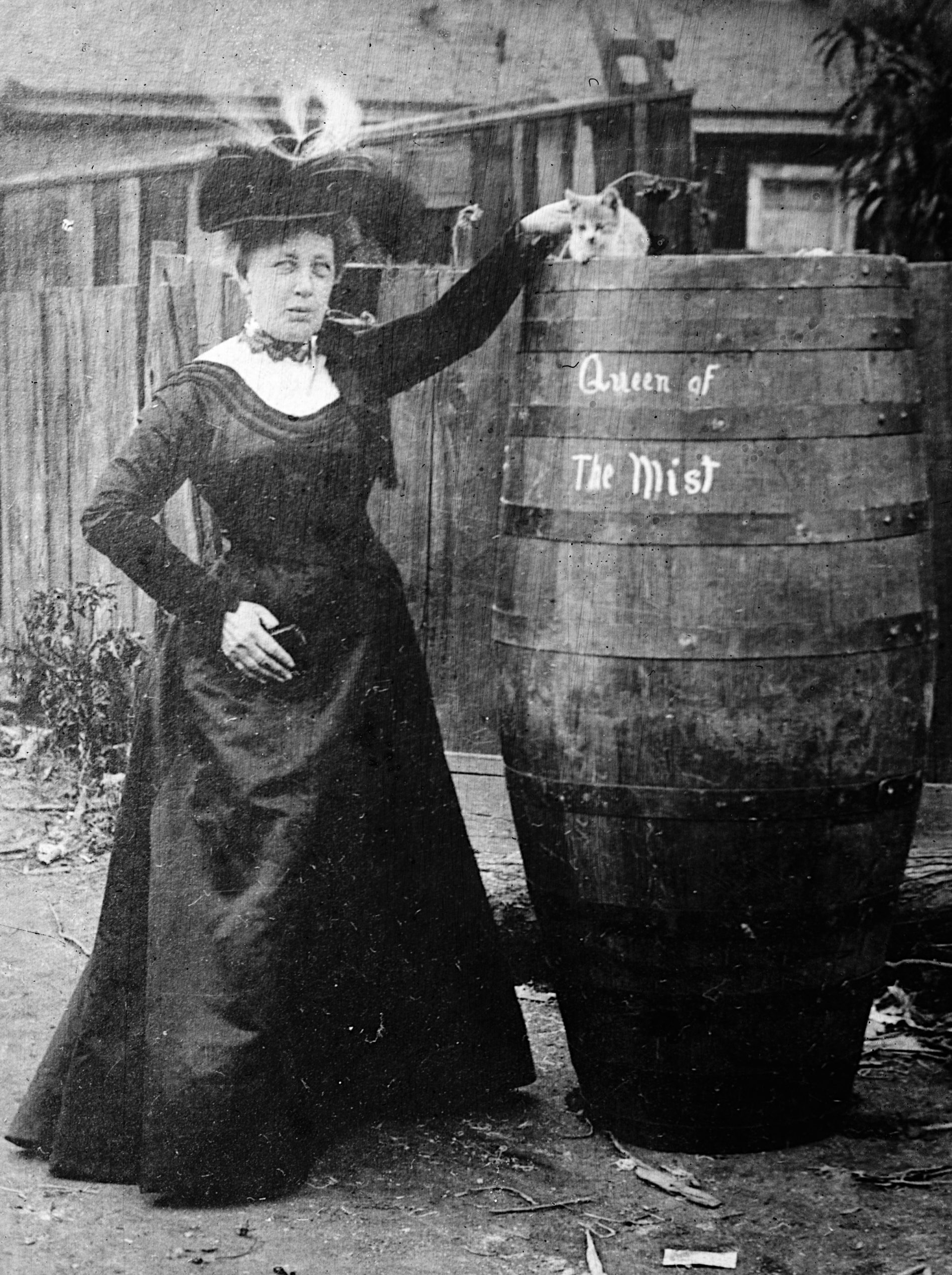
Featured photograph: Annie Edson Taylor beside the Queen of the Mist barrel, in a photograph published in her 1902 account. Bain News Service/Library of Congress; public domain. The cat’s identity is not certain. Source and rights.
Annie Edson Taylor stands beside a barrel almost as tall as she is. A cat looks out from the top, and the words Queen of the Mist appear on the wood. It is an extraordinary publicity portrait, but its most important detail is the woman herself.
On October 24, 1901, her 63rd birthday, Taylor went over Niagara’s Horseshoe Falls inside a barrel and survived. She became the first person to survive that journey in a barrel. The photograph records the public identity that followed: a teacher and widow transformed into a celebrated daredevil.
A plan shaped by money worries
Taylor was born in 1838 near Auburn, New York. By the time she planned the Niagara venture, she had experienced widowhood and spent years supporting herself through teaching. Her working life included teaching dance and music, as well as moving between places in search of opportunities.
The Niagara Falls National Heritage Area’s account places her in Bay City, Michigan, before the attempt and emphasizes her financial worries. The plunge was not simply a recreational adventure. Taylor hoped that doing something unprecedented would bring money and security.
That hope gives the story a different shape from the familiar image of someone chasing danger for its own sake. The risk was physical, but the hoped-for reward lay in the world of publicity, appearances and public curiosity. Survival was necessary for that plan, but survival alone could not guarantee an income.
Her own version of the idea
Taylor published Over the Falls in 1902. The short book preserves her account of the trip alongside material intended to establish its authenticity.
In it, she connected the idea with newspaper coverage of visitors traveling to Niagara during the Pan-American Exposition. She described financial aims, including helping herself and friends, and presented her determination in religious terms. These are her explanations of her motives, not thoughts a later biographer needs to invent.
The booklet also shows why a first-person account must be read carefully. It was part of the publicity surrounding the achievement, not a neutral investigation. Its biographical section gives a birth year inconsistent with the accepted 1838 date. The artifact is valuable precisely because it preserves both testimony and self-presentation.
A specially made barrel
This was not simply an ordinary container picked up at the riverside. Taylor helped design a barrel for the attempt. The heritage area describes oak construction reinforced with iron hoops. The container was roughly four and a half feet tall and weighed about 160 pounds.
Its protective interior was central to the plan. Taylor’s own account mentions cushions and restraints intended to limit the movement of her body. Even with those precautions, the venture exposed her to violent impacts and the danger of drowning.
The photograph makes the scale easier to understand. Taylor stands beside the apparatus rather than disappearing inside it. The comparison gives the viewer a human measure of an object that otherwise might remain an abstract detail in a newspaper story.
October 24, 1901
The barrel was taken onto the Niagara River and released upstream of the Horseshoe Falls. Taylor was carried over the falls and eventually recovered alive. The American Film Institute’s historical entry confirms both the date and her age, and notes the cut she sustained on her forehead.
It is important to distinguish this feat from earlier barrel journeys through the Niagara rapids. Those were dangerous undertakings too, but traveling through rapids and going over the Horseshoe Falls are not interchangeable events. Taylor’s place in history depends on the precise journey she survived.
Nor should survival make the undertaking seem safe in retrospect. We know the ending before we begin reading, while Taylor and the people helping her did not. The fact that she emerged alive cannot erase the uncertainty that existed when the barrel was released.
The photograph and the cat
The main image comes from the George Grantham Bain collection at the Library of Congress, with a public-domain reproduction available through Wikimedia Commons. The catalog identifies Taylor beside the marked barrel, with a cat at the top. The image was published in her 1902 book.
A cat was used in a preliminary barrel test, according to biographical accounts. However, the image description identifies the animal in this photograph only as likely to be that same cat. That small qualification matters. A plausible identification is not the same as a verified one.
The larger identification is secure: this is Taylor, not an actress portraying her. The full-length composition preserves her face, clothes and physical presence alongside the object that became inseparable from her name.
Fame was not the fortune she wanted
Taylor tried to earn money from her achievement through appearances and the sale of material about it. The biographical record of her later life describes financial disappointment rather than lasting prosperity. She died in 1921.
Her story also entered early cinema. The American Film Institute catalogs a 1903 Edison release titled Mrs. Taylor Going over Horseshoe Falls in a Barrel, but describes it as apparently a reenactment. Taylor did not repeat the plunge. A film title that promises an event is therefore not, by itself, proof that the camera captured the original moment.
That distinction is especially useful when bringing old images back to life. Photographs, promotional stories and moving pictures can preserve real people while presenting carefully shaped versions of their experiences. Keeping those differences visible makes the history more interesting, not less.
Taylor’s portrait endures because it holds a remarkable contradiction: an ordinary-looking woman beside an extraordinary means of survival. The barrel brought her a place in history. The security she wanted proved much harder to obtain.
Discover more people behind remarkable old photographs in our history article collection.
Get Your Images Done Too
If you want your photos bringing back to life, send me a message on any of my social media accounts.
Follow me across social media for historical photo restorations, AI colorizations, and videos bringing the past to life!